


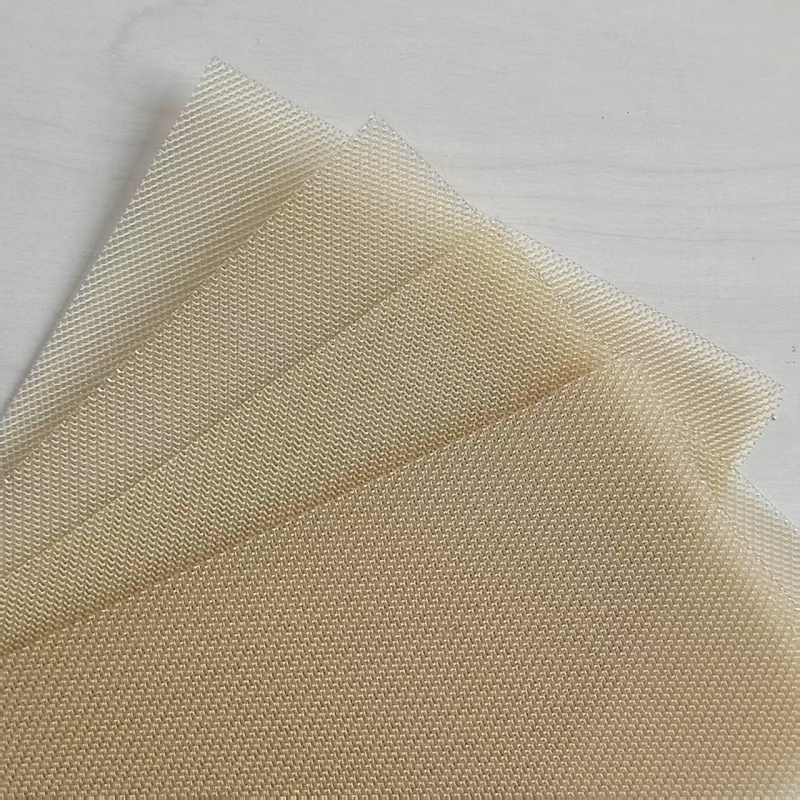
Mechanical and environmental performance testing parameters of PPS woven mesh
2026-03-27 15:53
Mechanical and environmental performance testing parameters of PPS woven mesh
I. Tensile performance testing parameters
testing items | Typical parameter range | Test standard / Description |
Longitudinal tensile breaking strength | 800–1200 N/5cm | According to GB/T 3923.1 or ASTM D4964, the clamping width is 5cm, and the tensile speed is 200mm/min |
Zonal tensile breaking strength | 900–1300 N/5cm | The weft yarn diameter is thicker, and the weft strength is slightly higher than the warp strength |
Elongation at break | 8%–15% | Pure PPS monofilament has high brittleness and a lower elongation rate compared to nylon/polyester mesh |
tensile modulus | 2.5–3.5 GPa | The modulus attenuation is small under high temperature, and it still retains about 70% of the room temperature modulus at 150℃ |
Seam/node strength | ≥70% Original net strong force | The four-piece integrated braided knot is strong, and the knot strength is close to the body of the net |
Tearing strength (tongue method) | warp:150–220 N;zonal:180–250 N | According to GB/T 3917.2, it reflects the tear resistance and propagation resistance of the net surface |
II. Flexibility and Toughness Testing Parameters
testing items | Typical parameter range | Test standard / Description |
bending stiffness | 0.5–1.2 mN·m | According to GB/T 18318, it reflects the softness of the net surface and has good rollability |
crease recovery rate | ≥85% | There are no permanent creases after repeated folding, and it exhibits good fatigue resistance
|
Flex resistance count | ≥10,000 | Bend back and forth at 180° at room temperature, with no fracture or obvious cracks |
Low temperature flexibility (-40℃) | No brittle fracture | After being placed in an environment at -40℃ for 2 hours and then bent, the mesh surface remains uncracked and unbroken |
III. Performance testing parameters under high temperature and high pressure
1. High-temperature mechanical properties
testing items | Typical parameters (150℃) | Typical parameters (180℃) | Instructions |
Tensile strength retention | ≥80% | ≥65% | 180℃ is the upper limit for long-term use, with controllable strength attenuation |
Change in elongation at break | ±2% | ±3% | It maintains dimensional stability under high temperatures with no noticeable creep |
Heat shrinkage rate (180℃, 30min) | ≤0.5% (meridional); ≤0.4% (zonal) | - | Excellent thermal stability, suitable for high-temperature filtration conditions |
2. High-pressure environmental performance
检测项目 | 典型参数范围 | 说明 |
hydrostatic pressure resistance | ≥0.5 MPa | The net surface is free of leakage and deformation under a water pressure of 0.5 MPa |
burst pressure | ≥1.2 MPa | The net surface can withstand instantaneous high-pressure impact without cracking |
Change rate of air permeability/water permeability under high pressure | ≤5% | Under a pressure of 0.3 MPa, the change in air/water permeability flux is minimal compared to that under normal pressure |
Creep rate (150℃, 0.2 MPa, 24h) | ≤1.0% | Long-term service under high temperature and high pressure, with stable dimensions and mechanical properties |
IV. Detection Suggestions and Application Tips
Test standards: For tensile strength/flexibility, refer to the mechanical testing standards for textiles (GB/T 3923, GB/T 3917, GB/T 18318); for high-temperature and high-pressure performance, refer to the standards for chemical filtration materials (such as HG/T 4102).
Performance optimization: If toughness is required, glass fiber reinforced PPS monofilament can be selected; if higher temperature resistance is needed, modified PPS (such as glass fiber/carbon fiber filled) can be used, and the long-term use temperature can be increased to 200℃.
Scenario adaptability: This net can stably maintain its filtration and mechanical properties in high-temperature and high-pressure corrosive environments within 180℃ and 0.3 MPa, making it suitable for harsh working conditions such as chemical and flue gas filtration.
Related News
Read More >-
![Shuguang Net Industry Series Products - Stainless Steel Braided Mesh]()
Shuguang Net Industry Series Products - Stainless Steel Braided Mesh
-
![Shenyang Shuguang Netting Co., Ltd. series product - pps woven mesh]()
Shenyang Shuguang Netting Co., Ltd. series product - pps woven mesh
-
![Stainless Steel Mesh for Use in Insulating Environments]()
Stainless Steel Mesh for Use in Insulating Environments
We supply SS316 plain finish steel mesh made of Japanese 316L wire, solving domestic SS304 flaws for stable, safe insulation applications.
-
![Can Stainless Steel Mesh Withstand the Long Term Impact of Mud?]()
Can Stainless Steel Mesh Withstand the Long Term Impact of Mud?
The 316L stainless steel wire mesh we produce is very corrosion-resistant and has high strength.
-
![Does the Tilt Angle of the Screen Affect the Material Flow Speed?]()
Does the Tilt Angle of the Screen Affect the Material Flow Speed?
Each batch of our 316L stainless steel wire mesh is produced in strict accordance with standards and is very corrosion-resistant.
-
![Why Is the River Channel Dredging Screen Specially Designed?]()
Why Is the River Channel Dredging Screen Specially Designed?
The 316L stainless steel wire mesh we provide can be applied to the screening needs of various industries.
-
![Is It More Efficient to Screen Materials with Customized Meshes?]()
Is It More Efficient to Screen Materials with Customized Meshes?
All of our 316L stainless steel wire mesh are produced in strict accordance with high standards, are corrosion resistant and have high strength.
-
![How to Choose a Stainless Steel Mesh That Suits Your Working Conditions?]()
How to Choose a Stainless Steel Mesh That Suits Your Working Conditions?
Our 316L stainless steel wire mesh can be used to screen the ore, which can withstand the impact of the ore and is not easy to damage.